






|
Conditions & Procedures
Hips
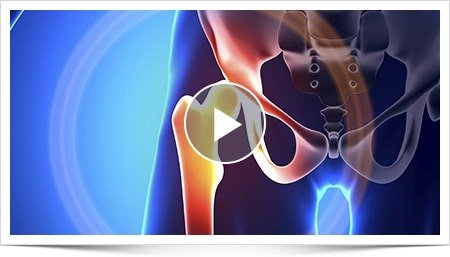
Normal anatomy of the hip joint
How does the hip joint work?
Find out more in this web based movie.
Arthroscopy of the Hip
Overview
Hip pain in the athletic population is commonly diagnosed as a simple hip
sprain or strain. However, the management of hip injuries has evolved
substantially with the advancement in diagnostic tools such as magnetic
resonance imaging and with new techniques and flexible instrumentation for hip
arthroscopy. Hip injuries can be divided into intra-articular (central and
peripheral compartment pathology), extra-articular (peritrochanteric space
pathology, iliopsoas pathology, and musculotendinous injuries), or central pubic
pain associated with athletic pubalgia. The most common cause for disabling
intraarticular hip pain in the athletic population is secondary to labral tears.
Currently, various hip pathology can be addressed arthroscopically including :
labral tears, femoroacetabular impingement, traumatic hip dislocation or
subluxation, hip instability, psoas impingement, snapping hip pathology
(internal or snapping psoas; external or snapping iliotibial band), removal of
loose bodies, cartilage injuries, injuries to the ligamentum teres, benign
tumors of the hip joint (synovial chondromatosis, pigmented villonodular
synovitis (PVNS), and osteochondroma) and peritrochanteric space pathology
(recalcitrant trochanteric bursitis, and gluteus medius and minimus tears).

Treatment of Labral Tears
Injuries to the acetabular labrum are the most consistent pathologic findings
identified during hip arthroscopy in athletes. The labrum is a
fibrocartilaginous structure that provides some structural resistance to lateral
and vertical motion of the femoral head within the acetabulum and has an
important sealing function which limits fluid expression from the joint space in
order to protect the cartilage layers of the hip. Mechanical symptoms and
restricted range of motion are oftentimes present. Pain with hyperflexion,
internal rotation and adduction (impingement position) is present in the
majority of patients. Labral tears typically are the result of some underlying
etiology including: traumatic subluxation or dislocation, atraumatic
microinstability or capsular laxity, underlying bony abnormalities such as
femoroacetabular impingement or dysplasia, and psoas impingement or symptomatic
internal coxa saltans.
Treatment strategies for labral pathology include both labral debridement for
irreparable tears, to labral repair for healthy tissue with good healing
potential. Vascularity studies have demonstrated that there is a good vascular
supply to the labrum stemming from the capsular side, however, the articular
portion of the labrum remains largely avascular. With an increased understanding
of the function of the labrum and its potential chondroprotective role, newer
repair strategies have been described to improve the chance of labral
preservation. It has become clear, however, that treatment of labral pathology
in isolation, without addressing underlying bony pathology has a greater chance
of failure. Arthroscopic treatment of labral tears has been shown to have
variable rates of effectiveness, with at least 67%, and as high as 100% of
patients satisfied with their outcomes. Satisfied patients have been shown to be
able to return to their pre-injury level of athletic competition and have
achieved good results by WOMAC or Harris hip scores.

Femoroacetabular Impingement
Femoroacetabular impingement is a well described pathologic condition that
has been associated with predisposing factors including slipped capital femoral
epiphysis, abnormal extension of the femoral head epiphysis, and acetabular
retroversion. Impingement can occur as a result of femoral sided impingement
(Cam impingement), acetabular rim impingement (pincer impingement), or a
combination of both which is the case in the majority of patients. Cam lesions
on the femoral head lead to shear forces of the nonspherical portion of the
femoral head against the acetabulum resulting in a characteristic pattern of
anterosuperior cartilage loss over the femoral head and corresponding dome, as
well as labral tears. Labral tears associated with cam impingement are more
commonly type 1 tears affecting the transition zone cartilage and leaving the
labral tissue in fairly good condition.
The second category of femoroacetabular impingement is the "pincer" type
lesion which is a result of repetitive contact stresses of a normal femoral neck
against an abnormal anterior acetabular rim as a result of "over coverage". This
situation results in degeneration, ossification and tears of the anterosuperior
labrum, as well as the characteristic posteroinferior "contre-coup" pattern of
cartilage loss over the femoral head and corresponding acetabulum. In this
setting, the acetabular labrum fails first which leads to degeneration and
eventual ossification, which worsens the over coverage (Type 2 tear). Overall,
the pincer type lesion has limited chondral damage compared to the deep chondral
inury associated with cam impingement.
Athletes with femoroacetabular impingement usually present with anterior
groin pain exacerbated by hip flexion, internal rotation, and adduction, and
physical examination reveals the "impingement sign." MRI usually demonstrates an
anterosuperior labral tear, and an anterosuperior cartilage defect on the
acetabulum. The alpha angle has been described as a radiographic and MRI
measurement that indicates abnormal offset at the head neck junction. Normal
alpha angles are less than 50 degrees with elevated values leading to increased
cartilage and labral pathology consistent with the described mechanism of
impingement. Rim impingement or pincer impingement can be seen on the
anteroposterior pelvis plain radiograph as a "figure-of-eight sign" where the
anterior wall of the acetabulum is lateral to the posterior wall suggestive of
acetabular retroversion.
The surgical goal of decompression of the femoral-head neck junction (Cam
decompression) is restoration of the normal head neck junction offset and
clearance of the femoral head within the acetabulum with full flexion and
rotation. At the completion of the bone resection, all bone debris is removed
from the peripheral compartment, and dynamic arthroscopy is performed to confirm
the absence of any residual impingement. A resection of less than 30% of the
head neck junction is recommended because this has shown to preserve the load
bearing capacity of the femoral neck.
Anterior overcoverage secondary to a pincer lesion can also be treated
arthroscopically. This can be performed in either the central compartment or the
peripheral compartment. First, the margins of the pincer lesion have to be
defined by probing with a flexible instrument. This lesion is usually associated
with a flattened, degenerative or cystic labrum. Pathologic pincer lesions
require bony resection which can be performed using a motorized burr. Resection
of the rim lesion oftentimes leads to destabilization or requires detachment of
the labrum in order to fully visualize the pathology. Fluoroscopy can be used
during this portion of the procedure to confirm reestablishment of the normal
relationship between the anterior and posterior walls of the acetabulum.
Following the rim resection, unstable but healthy residual labral tissue should
be refixed to the acetabular rim using arthroscopic suture anchoring techniques.
Good results have been reported in the literature for patients treated
arthroscopically for labral tears and associated femoroacetabular impingement,
with as high as 93% of patients able to return to sports and 78% able to remain
active at 1.5 years after surgery. While some studies suggest that patients with
associated chondral lesions fair worse than patients with isolated labral tears,
larger series have been unable to detect a correlation between chondral injury
and clinical outcomes. Although the current volume and quality of outcomes
literature is insufficient to conclude superior short-term outcomes when both
the labral tear and underlying impingement were surgically addressed compared to
treatment of the labral tear alone, reports on revision hip arthroscopy have
demonstrated that the highest failure rates are associated with patients who
have residual unaddressed bony impingement pathology.

Hip Dislocations and Subluxations
Athletes subject their hip to significant loads and can develop labral
pathology as a result of both traumatic and atraumatic hip instability. The
location of the labral pathology may be different than the most common
anterosuperior location seen in the setting of impingement and dysplasia.
Traumatic hip instability is typically the result of a posteriorly directed
force and ranges from subluxation to dislocation with or without concomitant
injuries. In addition to standard radiographic workup, the evaluation should
include an MRI that may demonstrate the characteristic triad of findings
described by Moorman et al: a hemarthrosis, a posterior acetabular lip fracture
or posterior labral tear, and an iliofemoral ligament disruption. Anterior
labral pathology is oftentimes present as well, and may represent a traumatic
avulsion of the labrum or indicate the presence of some underlying bony
impingement. The presence of a significant hemarthrosis may warrant aspiration
under fluoroscopy to decrease intracapsular pressure. An MRI is also useful to
detect AVN and help determine which patients may return safely to sports
activity.
Hip subluxations and dislocations have been described in a variety of
sporting activities including: American football, rugby, skiing, jogging,
basketball, soccer, biking, and gymnastics. Most hip dislocations sustained
during athletics are pure dislocations and, due to the relatively low energy
mechanism, usually have no associated fractures or small acetabular rim
fractures. Thus, surgical stabilization is often not warranted and active and
passive range of motion can begin as soon as tolerated by the patient. Hip
subluxation may be more subtle in its presentation and has been described with
both contact injuries (fall on a flexed knee) as well as non-contact injuries
while running with sudden changes in direction. Hip arthroscopy may play a role
after both dislocation and subluxation to address femoral head pathology, loose
bodies, chondral injuries and associated labral pathology. The optimal timing of
the procedure is debatable due to the concern of placing a hip in traction in
the acute phase of injury. If a loose body is not present, hip arthroscopy
should be delayed for at least 6 weeks so that a repeat MRI can be performed to
rule out the presence of early AVN before placing the hip in traction. However,
if a significant loose body is present, hip arthroscopy is an option and may
decrease the incidence of posttraumatic arthritis secondary to third body wear.

instaHip Instability
Atraumatic instability is a spectrum ranging from overuse injuries leading to
microinstability to patients with generalized ligamentous laxity. Overuse
injuries are common in athletes who particicpate in sports involving repetitive
hip rotation with axial loading (i.e. golf, figure skating, football, baseball,
ballet, martial arts, gymnastics, etc). The labrum or iliofemoral ligament may
be damaged from these repetitive forces. These abnormal forces cause increased
tension in the joint capsule which can lead to painful labral injury, capsular
redundancy, and subsequent microinstability. The hip must rely more on the
dynamic stabilizers for stability once the static stabilizers of the hip such as
the iliofemoral ligament or labrum are injured. The spectrum of atraumatic
instability also includes patients with hip pain secondary to more generalized
ligamentous lxity, or, in the extreme form, in patients with connective tissue
disorders such as Ehlers-Danlos syndrome or Marfan syndrome.

Psoas Impingement
Labral tears typically occur anterosuperiorly in association with
femoroacetabular impingement or dysplasia. Less commonly, labral pathology may
occur in an atypical direct anterior location in the absence of bony
abnormalities. This direct anterior injury may be related to compression of the
anterior capsule-labral complex by the psoas tendon as it crosses the anterior
acetabular rim and results in a unique constellation of intra-articular findings
reproducibly demonstrated at the time of arthroscopy. Arthroscopic findings are
most notable for the intimate relationship between the labral pathology
(inflamed labrum, or frank tear with mucoid degeneration) and the iliopsoas
tendon, which lies directly anterior to the labral abnormality and sometimes is
adherent or scarred to the anterior capsule. Torn labra can either be debrided
or reattached to the acetabular rim depending on the pattern of the tear. Labral
debridement or repair combined with lengthening of the iliopsoas has led to
subjective improvement in symptoms and may be a logical treatment option for
these patients.

Snapping Hip - Internal
Symptomatic internal snapping hip has been well described in the literature
and is most commonly associated with painful displacement of the iliopsoas
tendon over the iliopectineal eminence or over the femoral head. A variety of
both open and arthroscopic techniques have been described for surgical release
of a symptomatic painful snap.
Three different arthroscopic techniques have been described: 1. direct
detachment of the tendon off of the lesser trochanter; 2. release of the tendon
in the peripheral compartment; 3. release of the tendon in the central
compartment. All three have been shown to be effective at eliminating the
symptomatic snapping, however, release directly off of the lesser trochanter has
resulted in some cases of the development of heterotopic ossification that has
required subsequent excision.

Snapping Hip - External
External coxa saltans results from a thickened band of the posterior
iliotibial band or anterior gluteus maximus tendon sliding over the greater
trochanter. With the hip extended this band lies posterior to the greater
trochanter, and during hip flexion this band slides anteriorly over it. Due to
the tight attachments of the tensor fasica lata anteriorly, the gluteus maximus
posteriorly, and association with aponeurosis of the gluteus medius, the
iliotibial band remains tightly draped over the greater trochanter throughout
hip range of motion. Any irritation or injury to the underlying bursa results in
inflammation and the addition of pain with the snapping.
Diagnosis is confirmed by history, physical examination, and dynamic
ultrasound displaying real time images of the iliotibial band snapping over the
greater trochanter. Although conservative treatment is usually successful, small
numbers of patients remain symptomatic. A variety of different open treatments
for recalcitrant external coxa saltans have been described involving excision of
an ellipsoid-shaped portion of the iliotibial band overlying the greater
trochanter and removal of the trochanteric bursa. Endoscopic techniques are
gaining in popularity and have demonstrated similar positive outcomes to the
open surgical approaches.

Removal of Loose Bodies
Hip arthroscopy is ideally suited for the removal of loose bodies. Loose
bodies may or may not be ossified, and are readily identified by radiographic
studies only when calcium is present. If not evident on plain films, CT scans
are highly sensitive for visualization; intraarticular fragments may be obscured
with MR imaging. Symptoms are oftentimes described as mechanical locking or
catching. When persistent symptoms are present even in the absence of clear
evidence of ossified loose bodies, arthroscopy is a way to confirm the diagnosis
suggested by clinical examination as well as provide simultaneous treatment with
minimal associated morbidity.
Loose bodies may occur as an isolated fragment, such as after dislocation or
with osteochondritis dissecans, or as multiple bodies or clusters such as is
seen in synovial chondromatosis. In cases of multiple bodies, it is essential to
fully explore the joint and be sure to remove all fragments. Often multiple
bodies associated with synovial chondromatosis adhere to the synovium around the
fovea and must be morsellized prior to removal by arthroscopy.

Cartilage Injury
Within the discipline of sports medicine, articular cartilage injuries in the
hip have received considerably less attention than other joints, largely due to
the difficulty that practitioners have had with accurate assessment.
Non-arthritic cartilage injuries in the hip refer to focal chondral defects on
either the femoral or acetabular side of the joint. Focal chondral defects on
the femoral side are relatively uncommon, however, may result from axial
loading, or shear injury of the head within the socket. Hip subluxation and
dislocation oftentimes will result in a shear injury to the cartilage surfaces
of the femoral head. These cartilage injuries may be treated with arthroscopic
techniques to stabilize loose cartilage flaps and microfracture areas of exposed
bone particularly if the injury is not in a weight-bearing zone. If the injury
is in the weight-bearing zone of the femoral head, consideration should be given
to cartilage transplant procedures which need to be performed as open procedures
in the majority of cases. Byrd has described a more common mechanism of chondral
injury to the femoral head with a direct blow to the greater trochanter, as can
occur as the result of a fall or collision. This so-called "lateral impact
mechanism" can result in an area of full-thickness articular cartilage loss
caused by either shear or compressive forces on the medial aspect of the femoral
head or chondronecrosis in the superomedial weight-bearing portion of the
acetabulum. Similar arthroscopic or open surgical approaches can be used to
address these chondral injuries.
Cartilage injuries on the acetabular side are more common and typically
present as localized cartilage delamination
in the anterosuperior weight-bearing zone of the acetabular rim. The most common
underlying condition resulting in these types of cartilage defects is
femoroacetabular impingement which leads to damage of the transition zone
cartilage with extension over time into the articular cartilage of the
acetabulum due to Cam lesions entering the hip joint during flexion and
rotation. These cartilage lesions may be treated with simple debridement to
stabilize cartilage flaps, abrasion chondroplasty, or microfracture. Currently
there are no studies to provide any long term data on the utility of any of
these techniques.

Injuries to the Ligamentum Teres
The function of the ligamentum teres remains unclear. The presence of
arteries around the ligamentum suggests a role in providing a blood supply to
the developing hip. In addition, it has been suggested that this ligament plays
a biomechanical role that contributes significantly to the stabilization of the
hip. Analysis of the material properties of this ligament has demonstrated
similarities to other ligaments and confirms its ability to resist dislocation
forces applied to the femoral head. Patients suffering from ligamentum rupture
as a result of trauma or dislocation will oftentimes suffer from symptoms of
instability and pain.
Although some authors have reported a low incidence of ligamentum teres
ruptures seen at arthroscopy, Byrd found these lesions to be the third most
common problem encountered among athletes undergoing hip arthroscopy. Acute
disruptions of the ligamentum are thought to occur as a result of exaggerated
movements of adduction and external rotation, although hip abduction is
oftentimes the injury mechanism described with patient history. Diagnosis of
these injuries can be difficult and a high index of suspicion with careful
attention to the injury mechanism and the physical examination are critical to
accurate evaluation.
Ligamentum teres injuries in high impact sports such as football may lead to
recurrent subluxation of the hip. The high incidence of degenerative arthritis
associated with complete ligamentum teres ruptures has been attributed to the
original injury in many cases, however, recurrent instability and subluxation
episodes may cause repetitive injury to the femoral head and account for an
increased incidence of AVN in these patients. Arthroscopy of persistently
symptomatic lesions can clearly demonstrate ligamentum teres pathology, and
athletes have been found to respond well to arthroscopic debridement of the
disrupted and entrapped fibers.

Benign Tumors of the Hip Joint
Benign tumors of the hip joint can be the source of recalcitrant hip pain,
and include disorders such as synovial chondromatosis, pigmented villonodular
synovitis (PVNS), and osteochondroma. Synovial chondromatosis results in
multiple loose bodies within the space between the femoral head and the
acetabulum. Pigmented villonodular synovitis (PVNS) is a benign tumor of the
inner lining of the joint capsule known as the synovium. It can be in a nodular
or diffuse form. Osteochondromas are bony outgrowths that can occur anywhere
throughout the body. When they occur within the hip joint, they can cause
abrasive irritation of the cartilage surfaces within the joint.
Peritrochanteric Space
Disorders of the lateral or peri-trochanteric space, previously grouped into
the "greater trochanteric pain syndrome", can now be addressed endoscopically.
Recalcitrant trochanteric bursitis, and gluteus medius and minimus tears are
entities that can effectively be treated within the lateral compartment of the
hip.

Recalcitrant Trochanteric Bursitis
Trochanteric bursitis is characterized by chronic, intermittent aching pain
over the lateral aspect of the hip. The diagnosis can typically be confirmed
with accurate history and physical exam. Magnetic resonance imaging, although
not necessary to make the diagnosis, may reveal increased signal intensity of
the trochanteric bursa on T2 weighted images. Conservative treatment is the
mainstay of therapy with physical therapy and the judicious use of a combined
corticosteroid and local anesthetic preparation for diagnostic and therapeutic
purposes. Numerous open surgical procedures have been described for failure of
conservative treatment, and there is a growing interest in arthroscopic (or
endoscopic) bursectomy in the treatment of trochanteric bursitis.

Gluteus Medius and Minimus Tears
Traditionally, greater trochanteric pain syndrome has been described as
inflammation of the trochanteric bursae that lies predominantly over the
posterior facet of the trochanter. There is increasing evidence to suggest that
persistent pain and weakness in this region may, in fact, result from primary
deficiencies in the tendon attachments of the gluteus medius and / or minimus.
Tears of the gluteus medius and minimus tendons share similarities to tears of
the rotator cuff tendons in the shoulder. As with cuff tears in the shoulder, it
has been hypothesized that these "rotator cuff tears" of the hip are attritional
injuries associated with increasing age. Physical examination reveals a slight
trendelenberg gait, pain, and weakness with resisted abduction of the hip when
compared to the contralateral extremity. The combination of abductor weakness,
persistence of symptoms after conservative treatment and positive magnetic
resonance imaging studies, showing increased signal in the tendon, confirm the
diagnosis of abductor tears.
Summary
Sports-related hip pathology has gained increased recognition as a more
complete understanding of the wide variety of intra and extra articular hip
conditions has evolved. Currently the role of hip arthroscopy in the management
of intra-articular injuries allows for reproducible surgical treatments for
athletes who have failed conservative measures. Appropriate indications for hip
arthroscopy include management of central compartment pathology involving the
labrum, chondral surfaces, ligamentum teres, capsular tissue, and centrally
located loose bodies. Peripheral compartment arthroscopy is effective for
treatment of peripheral loose bodies, displaced labral flaps, and treatment of
both cam and rim impingement lesions associated with femoroacetabular
impingement. Pathologic conditions of the iliopsoas tendon can be addressed via
the central or peripheral compartment. The peritrochanteric space or lateral
compartment of the hip can be accessed endoscopically for effective treatment of
recalcitrant cases of trochanteric bursitis, external snapping hip, and
symptomatic abductor tendon tears.

|